
The starting point of Capital, often regarded as one of the most important works in modern economics, is the idea of surplus production. According to this theory, capital cannot be accumulated without surplus production. Surplus leads to the accumulation of capital, and accumulated capital gives rise to industry. It is a theory that still seems remarkably applicable to the rapidly developing modern society of the twenty-first century.
For this reason, many countries in the Northern Hemisphere, where winters are cold, had no choice but to produce and store surpluses in order to survive the winter. Those surpluses encouraged the accumulation of capital, and this, in turn, helped them become wealthy countries. It is a very simple assumption, but it appears to fit surprisingly well.
By contrast, countries in tropical regions, where the climate remains warm or hot throughout the year, had less reason to create surpluses. In such places, surplus production could simply mean waste. There was little point in storing food when there was no effective way to preserve it and when stored food would eventually rot. Fruits and plants were abundant everywhere, so people could simply go outside, pick what they needed, and eat. There was little reason to store food or work hard to harvest more than necessary. In a sense, how could such a place not have seemed like paradise?
From this perspective, I sometimes wonder whether tropical countries such as the Philippines may be among the greatest victims of modern economics. They merely enjoyed the natural advantages given to them, yet today they are labeled as developing countries, given foreign aid, and sometimes treated with a degree of condescension. How can it be considered a fault that people became relaxed, cheerful, and innocent because of the warm climate?
The fast-moving, globally connected modern economy has further accelerated poverty in tropical countries such as the Philippines. Under the name of globalization, the Philippines has had to accept products mass-produced by Western industrial civilization, while having relatively few goods of its own to sell in return. Even the products it does export are often crops such as bananas and pineapples, produced almost like factory goods on large plantations.
People who once lived at a more relaxed pace have gradually been forced, often without realizing it, into the hectic rhythm of modern life. That way of living has come to be treated as the proper and normal standard. It is a strange situation. People are branded as citizens of a poor country and looked down upon without even understanding why they must live according to this unfamiliar standard. As someone observing this reality, I cannot help but feel saddened by it.
For reasons similar to the absence of surplus products, Filipino food is based largely on cooking fresh ingredients. It is difficult to find foods that have been fermented for long periods, like Korean doenjang or soy sauce. One exception is bagoong, a fermented seafood paste similar to Korean salted shrimp. Bagoong made from anchovies is called ginamos, and it closely resembles Korean fermented anchovy sauce. Apart from these, fermented foods are relatively uncommon in the Philippines.
The Philippines was under Spanish colonial rule for nearly 300 years and inherited many Spanish cooking methods. It had relatively little opportunity to develop its own cuisine independently. Colonial rule, with its exploitation and forced labor, made it difficult for the local economy to develop, and this also limited the development of food culture. It is therefore not an exaggeration to say that many Filipino dishes were shaped by Spanish influence.
In addition, because much of the population lived under difficult economic conditions, it was not easy for complex dishes requiring long preparation times to develop. Since there was little need for preservation, people could simply cook freshly harvested ingredients. This tendency remains visible in the modern Philippines. Many people cannot afford expensive ingredients, and because such ingredients are inaccessible, dishes based on them are less likely to become widely popular. Even ingredients that are naturally abundant in the Philippines often fail to develop into everyday cuisine because, for various reasons, ordinary people have limited access to them.
Abundant shellfish, mangrove crabs known as alimango, giant freshwater prawns called ulang, and expensive fish such as lapu-lapu are all difficult for most Filipinos to afford. Strangely enough, many Filipinos, despite living in an island country, appear to have seafood allergies, and relatively few people seem to enjoy seafood other than fish. This may be something that is difficult to understand unless one has actually lived in the Philippines.
Anyone who cooks knows that it is surprisingly difficult to create deep flavor using only natural ingredients. If you put fish into water and make soup, the result may taste bland. The same can happen when beef is added to water. This is understandable because the quantity of the ingredients is too small in relation to the amount of water. In other words, the concentration is not strong enough. Once too much water is added, the original ingredients lose much of their flavor.
Long ago, when the entire Korean population was poor, one piece of meat or a few grains had to be shared among the whole family. Meals were often stretched by turning ingredients into soup. During that period, our ancestors discovered a way to create flavor. They found the magic of fermentation.
Fermentation can be understood as a process in which proteins are broken down into amino acids. Over a long period, ingredients develop amino acids that produce a distinctive savory taste. Even a small amount of a fermented ingredient can dramatically improve the flavor of soup.
Because Korea has long, cold winters, it developed many kinds of fermented food. Representative examples include doenjang and soy sauce made mainly from soybeans, fermented anchovy sauce, salted shrimp, and many other natural seasonings. These foods can be seen as the result of a desperate struggle for survival: a way to endure the long winter and make limited ingredients taste good enough to share.
For this reason, Korean cooking can often produce rich flavors without relying on modern commercial seasonings such as Miwon. Miwon is monosodium glutamate, or MSG, made through the fermentation of sugarcane. MSG is essentially a form of glutamate, an amino acid associated with savory taste. Because it can be mass-produced in factories, it is very inexpensive, and even a small amount can greatly improve flavor. It would not be an exaggeration to say that Miwon brought about a revolution in cooking.
As mentioned earlier, the Philippines historically had less need for fermentation. Therefore, unlike Korean cuisine, Filipino cooking does not widely use traditional fermented seasonings such as doenjang, gochujang, or fish sauce in the same systematic way. Such ingredients are used in some dishes, but it would be difficult to say that they are central to most Filipino cooking.
Without fermented pastes and sauces, it is naturally harder to create deep flavor, so MSG is commonly used. Even adobo, one of the Philippines’ best-known dishes, is often prepared with soy sauce and MSG. The reason is simple: it is an inexpensive and fast way to make food taste good.
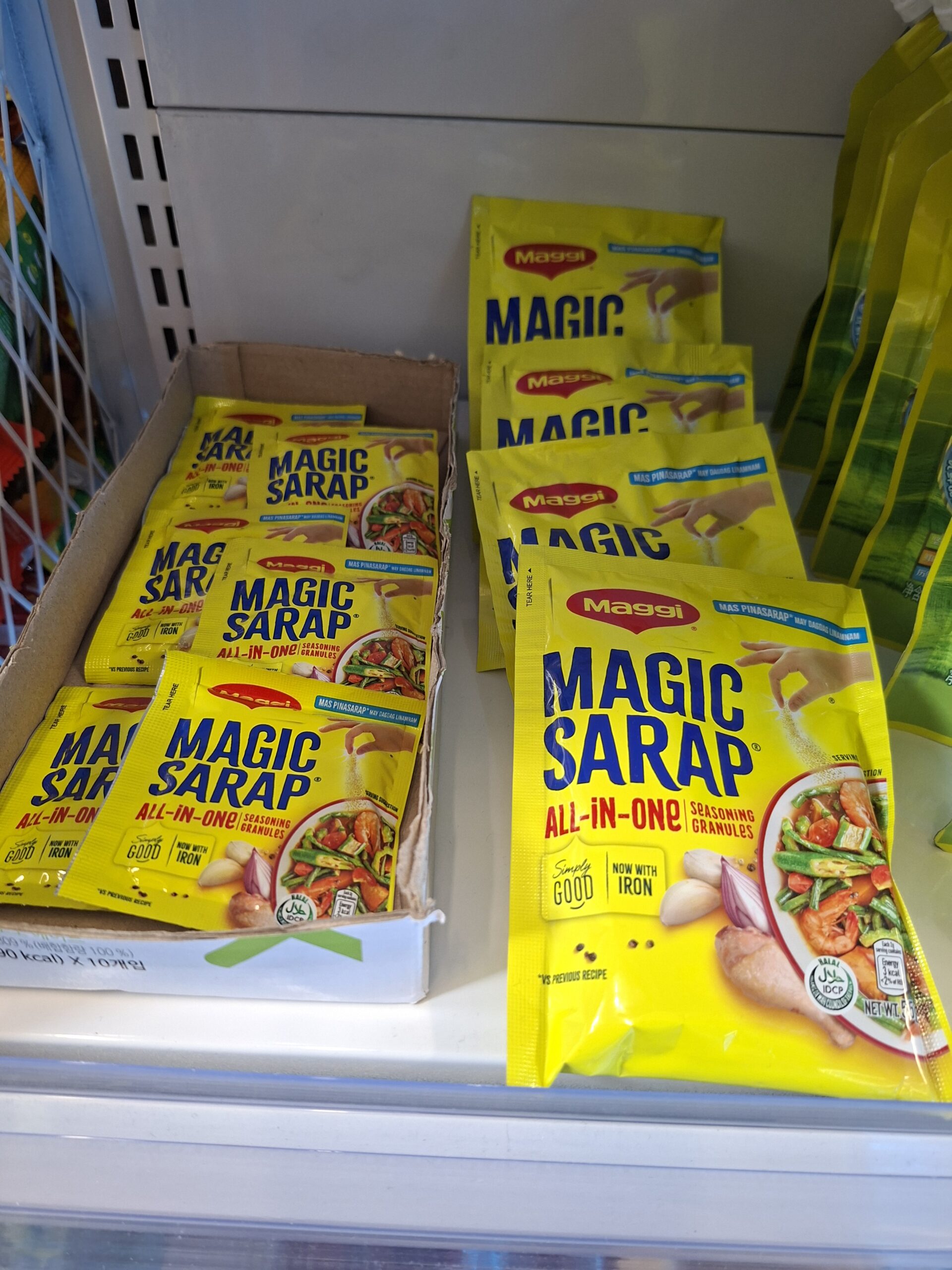
The use of MSG has continued to evolve. Today, one of the most popular seasonings is Magic Sarap, a powdered seasoning produced by Maggi and made from a mixture of various flavoring ingredients.
It may not be much of an exaggeration to say that almost every kind of food is cooked with Magic Sarap. Filipinos have become so accustomed to its taste that food made without it may be considered bland. Since it combines the flavor-enhancing effect of Miwon with various additional seasonings, how could it fail to taste good? It would not be excessive to describe it as a flavor bomb.
Because large amounts of MSG and Magic Sarap are used in so many dishes, the flavors of Filipino food have, to some extent, become standardized. If one were to define the general taste of Filipino food, it might be described as salty, sweet, and intensely savory: the saltiness of soy sauce, the sweetness of sugar, and the umami of Magic Sarap combined into a distinctly Filipino flavor.
Sometimes, when I eat out after a long time and recognize the taste of Magic Sarap in the food, I suddenly think, “I really have lived in the Philippines for a long time.”
At moments like that, the lingering aftertaste of Magic Sarap—slightly bitter, yet also sweet—remains on the tip of my tongue, almost as if I were quietly turning over an old memory.
Leave a Reply