
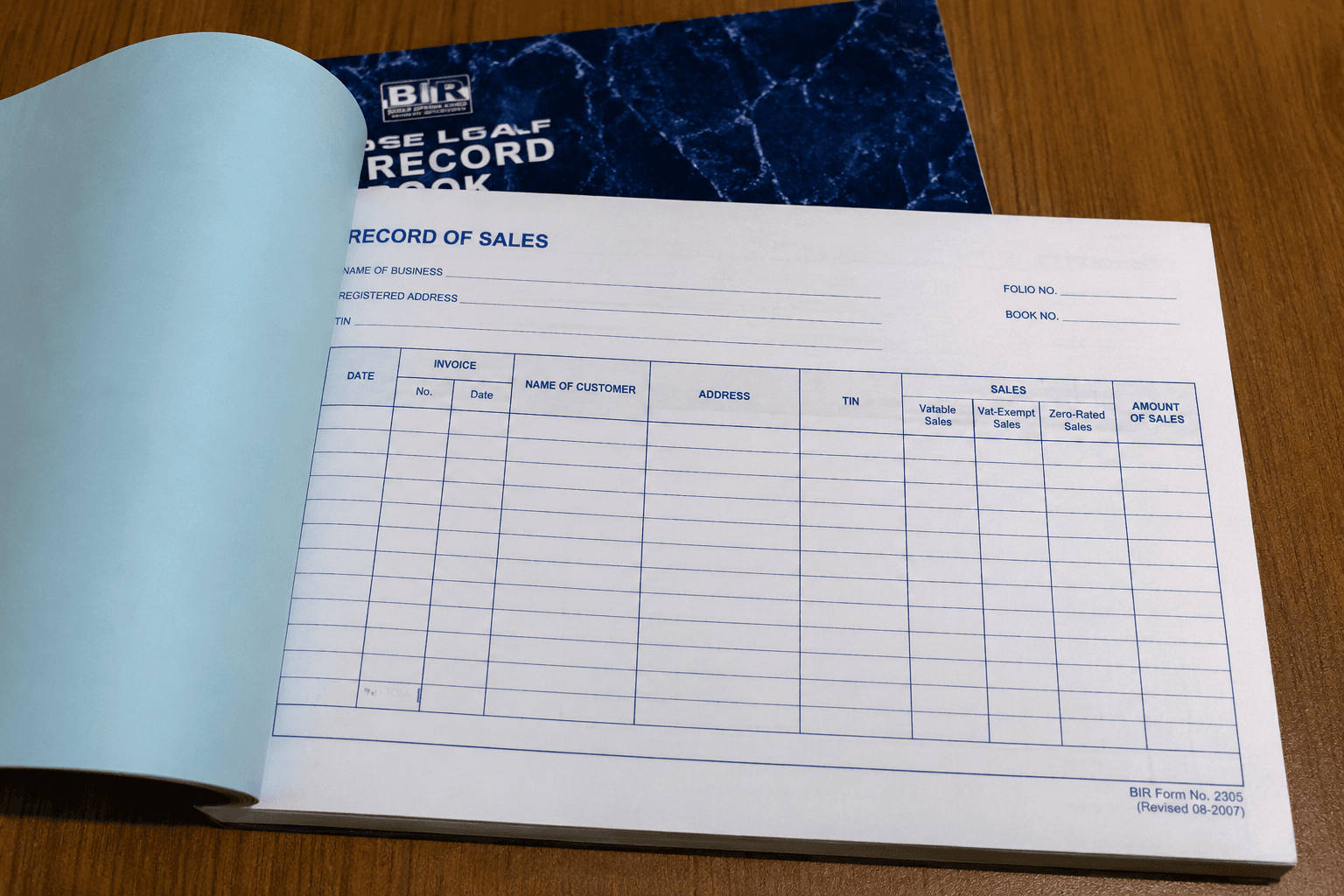
Registering a corporation with the Securities and Exchange Commission (SEC) is only one part of establishing a business in the Philippines.
Once the company has been incorporated, it must also enter the Philippine tax system. This means registering with the Bureau of Internal Revenue (BIR), obtaining the proper tax registration, setting up books of accounts, arranging compliant invoices, and understanding which taxes the company will be required to file and pay.
For foreign investors, the process can initially be confusing because company registration and tax registration are handled by different government agencies.
The SEC establishes the corporation as a legal entity, while the BIR registers the corporation as a taxpayer.
This guide explains how BIR business tax registration works for corporations in the Philippines in 2026, including domestic corporations, One Person Corporations (OPCs), and Philippine corporations with foreign shareholders.
Business Tax Registration in the Philippines At a Glance
For most newly incorporated businesses, BIR registration involves:
- Registering the corporation with the SEC.
- Determining the BIR Revenue District Office (RDO) responsible for the company’s registered address.
- Completing BIR Form 1903.
- Submitting the SEC Certificate of Incorporation and Articles of Incorporation.
- Determining the taxes applicable to the business.
- Paying the applicable ₱30 documentary stamp tax for registration.
- Receiving the company’s BIR Certificate of Registration.
- Setting up the company’s books of accounts.
- Setting up BIR-compliant invoices.
- Beginning the company’s regular tax filing and payment obligations.
The old ₱500 BIR Annual Registration Fee is no longer required. The BIR stopped collecting this fee effective January 22, 2024 following the Ease of Paying Taxes Act.
Table of Contents
What Is the BIR?
The Bureau of Internal Revenue, commonly known as the BIR, is the Philippine government agency primarily responsible for administering and collecting national internal revenue taxes.
For a corporation doing business in the Philippines, the BIR is therefore one of the government agencies the company will deal with throughout its operating life.
The BIR handles matters such as:
- Taxpayer registration
- Corporate income tax
- Value-Added Tax (VAT)
- Percentage tax, where applicable
- Withholding taxes
- Registration of books of accounts
- Invoicing requirements
- Tax return filing
- Tax payments
- Tax audits and assessments
Think of the SEC and BIR as performing two very different functions.
SEC registration creates the corporation.
BIR registration brings that corporation into the Philippine tax system.
Who Is This Guide For?
This guide focuses on corporations rather than sole proprietorships.
It is particularly relevant to:
- Philippine domestic corporations
- One Person Corporations (OPCs)
- Corporations with Filipino and foreign shareholders
- 100% foreign-owned Philippine corporations where foreign ownership is legally permitted
- Resident foreign corporations licensed to do business in the Philippines
- New corporations preparing to start commercial operations
Foreign ownership restrictions are separate from BIR tax registration.
Before reaching the BIR registration stage, foreign investors should first determine whether their proposed business activity allows the intended level of foreign ownership.
PhilifeGuide Related Guide: Read our guide to Foreign Ownership in the Philippines: What Businesses Can Foreigners Own in 2026? for an explanation of which businesses foreigners may own and the capital and regulatory requirements that may apply.
Business Tax Registration Philippines: When Must a Corporation Register with the BIR?
A corporation should not wait until it is already operating for several months before considering BIR registration.
Under current BIR rules, corporations generally have to register on or before the commencement of business.
The BIR considers commencement of business based on the earliest applicable event, including the first sales transaction or the lapse of 30 calendar days from the issuance of the relevant SEC registration, LGU permit, or similar registration document.
For a newly incorporated company, this means that BIR registration should be treated as an immediate post-incorporation task rather than something to be completed later when the company becomes profitable.
Practical Example
Suppose ABC Philippines Inc. receives its SEC Certificate of Incorporation on September 1.
The shareholders plan to renovate an office and begin actual operations several weeks later.
They should not assume that they can simply postpone BIR registration until the business becomes profitable or starts receiving substantial revenue.
The BIR registration deadline can arise based on the company’s registration and commencement-of-business rules even before the business becomes fully operational.

Step 1: Determine the Company’s BIR Revenue District Office
The BIR operates through local Revenue District Offices, commonly called RDOs.
For most corporations, the appropriate RDO is determined by the location of the company’s head office or registered business address.
For example, a corporation with its registered head office in Taguig will generally deal with the BIR office having jurisdiction over that address rather than an RDO chosen by one of its shareholders.
This is important because many future BIR transactions are connected to the company’s registered RDO.
The BIR also provides online registration channels, but understanding which RDO has jurisdiction over the business remains important.
Step 2: Complete BIR Form 1903
The primary registration form for corporations and other non-individual taxpayers is:
BIR Form No. 1903 – Application for Registration for Corporations, Partnerships and Other Non-Individual Taxpayers
For manual registration, the BIR’s July 2025 documentary checklist requires two original copies of Form 1903 for covered corporations.
The form contains information about the corporation including:
- Registered corporate name
- Registered address
- SEC registration information
- Primary business activity
- Contact information
- Accounting period
- Tax types
- Authorized representative
- Branches or facilities, where applicable
Particular care should be taken when identifying the company’s business activity and tax types, because these affect the company’s future filing obligations.
Step 3: Prepare the Required Corporate Documents
For a Philippine domestic corporation, the principal documents normally include:
- BIR Form 1903
- SEC Certificate of Incorporation
- Articles of Incorporation
The BIR’s current documentary checklist recognizes both conventional and digital SEC incorporation documents.
For a foreign corporation establishing a Philippine branch rather than forming a separate Philippine subsidiary, the documentation is different. The BIR generally requires the company’s License to Do Business in the Philippines together with the relevant corporate documents.
Additional documents may also be required depending on how the application is submitted.
If a representative handles the BIR registration for the corporation, the company may need a Board Resolution or Secretary’s Certificate authorizing that representative, together with the representative’s government-issued identification.
Basic Checklist for a Domestic Corporation
| Requirement | Typical Purpose |
|---|---|
| BIR Form 1903 | Application for tax registration |
| SEC Certificate of Incorporation | Proof that the corporation legally exists |
| Articles of Incorporation | Corporate structure and purpose |
| Authorized representative documents | Required when someone acts for the company |
| Invoice documentation | To establish compliant invoicing |
| Books of accounts information | To establish accounting records |
| ₱30 DST | Documentary stamp tax connected with registration |
Requirements can vary depending on the corporation, business activity, registration method, and RDO, so applicants should check the current BIR checklist before filing.
Step 4: Choose How to Register with the BIR
The BIR now provides several ways for businesses to complete or initiate registration.
These include:
1. Manual Registration at the RDO
The corporation can submit its application directly to the appropriate Revenue District Office.
This can still be useful when the company’s registration involves unusual tax classifications, several business activities, or questions that need to be addressed directly with the RDO.
2. Online Registration and Update System (ORUS)
The Online Registration and Update System, or ORUS, allows taxpayers to perform various registration transactions electronically.
Under the BIR’s current corporation registration checklist, taxpayers registering a business through ORUS can generate, receive, and print an electronic Certificate of Registration after completing the required online process and paying the applicable ₱30 documentary stamp tax.
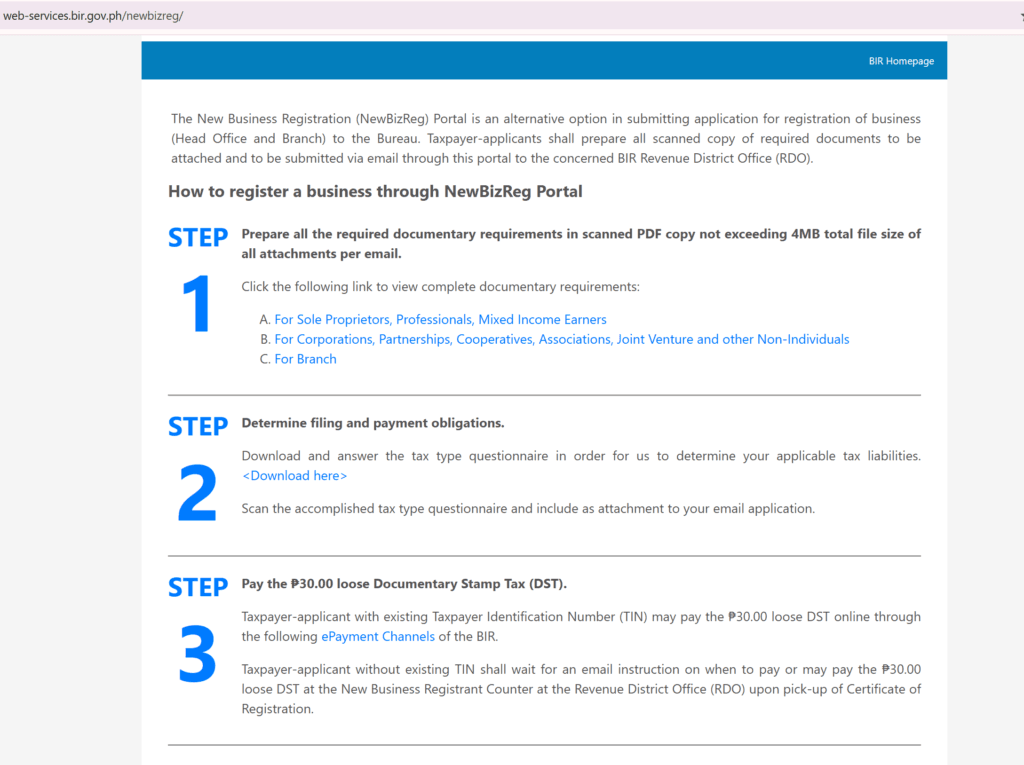
3. NewBizReg
The BIR’s New Business Registration Portal, known as NewBizReg, provides another method for submitting new business registration requirements.
Applicants prepare scanned copies of their documents and submit them electronically to the appropriate RDO.
The BIR states that complete NewBizReg applications are generally processed within three working days from the email acknowledgement of complete requirements.
The BIR also recognizes other registration channels, including the Philippine Business Hub, depending on the transaction.
Step 5: Determine Which Taxes Apply to the Corporation
One of the most important parts of BIR registration is determining the company’s tax types.
Not every corporation has exactly the same BIR filing obligations.
The applicable taxes depend on factors such as:
- Type of business
- Expected annual sales
- VAT status
- Employees
- Rent
- Professional service providers
- Payments to suppliers
- Imports
- Industry-specific taxes
- Tax incentives
The company’s Certificate of Registration will help identify its registered tax obligations.
Corporate Income Tax
A Philippine domestic corporation is generally subject to corporate income tax on its taxable income.
Under the CREATE tax framework, the standard corporate income tax rate for domestic corporations is generally 25%.
A lower 20% corporate income tax rate may apply to qualifying domestic corporations with:
- Net taxable income not exceeding ₱5 million, and
- Total assets not exceeding ₱100 million, subject to the applicable statutory conditions.
This is important because a company’s capitalization does not automatically equal its taxable income.
For example, a company may have ₱25 million in paid-up capital but generate only a few million pesos of taxable income.
Corporate income tax is generally calculated based on taxable income, not simply on how much money the shareholders originally invested.
VAT or Percentage Tax
Another important issue is whether the company should be registered for Value-Added Tax (VAT).
The Philippine tax system applies a statutory VAT registration threshold, and the threshold is subject to periodic adjustment under the Ease of Paying Taxes Act. BIR regulations continue to reference the ₱3 million threshold while providing for periodic CPI-based adjustment.
A corporation whose transactions exceed the applicable VAT threshold generally becomes subject to VAT registration unless its transactions are specifically exempt.
Businesses below the mandatory threshold may fall under percentage tax rules where applicable, or in certain cases may elect VAT registration.
This decision deserves careful consideration because VAT registration affects:
- Pricing
- Invoicing
- Input VAT
- Output VAT
- Tax returns
- Accounting procedures
- Customers’ ability to claim input VAT
For a business expecting substantial purchases, imports, corporate customers, or rapid growth, VAT planning should ideally be considered before commercial operations begin.
Withholding Taxes
New business owners are sometimes surprised to discover that Philippine businesses can also act as withholding agents.
Depending on its transactions, a corporation may be required to withhold and remit taxes on payments such as:
- Employee compensation
- Rent
- Professional fees
- Certain supplier payments
- Contractor payments
- Other payments subject to expanded withholding tax
The specific withholding obligations depend on the nature of the company’s payments and BIR classification.
This is one reason proper tax registration should be coordinated with the company’s accountant rather than treated simply as a one-time government registration exercise.
Corporations Cannot Use the 8% Income Tax Option
Foreign entrepreneurs sometimes encounter information online about an 8% income tax option for small businesses.
This can be misleading when establishing a corporation.
The 8% income tax option is associated with qualifying self-employed individuals and professionals. It is not the normal corporate income tax regime for a corporation.
A Philippine corporation is taxed separately as a juridical entity under the corporate tax rules.
This is one of the reasons PhilifeGuide recommends separating information about corporations from guides written for freelancers and sole proprietors.
Step 6: Pay the ₱30 Documentary Stamp Tax
One of the biggest changes in BIR registration in recent years concerns the old annual registration fee.
Older articles may tell new businesses to pay:
₱500 Annual Registration Fee + ₱30 Documentary Stamp Tax
That information is outdated.
The BIR stopped collecting the ₱500 Annual Registration Fee effective January 22, 2024 following implementation of the Ease of Paying Taxes Act. Businesses are also no longer required to file Form 0605 simply to pay that annual registration fee.
For current new-business registration, the BIR’s guidance identifies the applicable ₱30 loose Documentary Stamp Tax connected with the Certificate of Registration.
Important
If you find a BIR registration guide telling you that every new corporation must still pay an annual ₱500 registration fee, check when the article was written.
It may be using pre-2024 rules.
Step 7: Receive the BIR Certificate of Registration
After completing the registration requirements, the corporation receives its Certificate of Registration, commonly referred to as the COR.
The Certificate of Registration is one of the company’s most important tax documents.
It identifies key information relating to the taxpayer and its registered tax obligations.
When reviewing the COR, the company’s accountant or responsible officer should make sure that the tax types registered with the BIR match the company’s actual activities.
Do not simply receive the Certificate of Registration and file it away.
The taxes appearing in the company’s BIR registration can create recurring filing obligations even during periods when the business has little or no activity.
Step 8: Set Up the Company’s Books of Accounts
Every corporation needs proper accounting records.
The BIR recognizes different types of books of accounts.
For new business taxpayers, these may include:
- Manual Books of Accounts
- Loose-Leaf Books of Accounts
- Computerized Books of Accounts
In 2025, the BIR specifically clarified that a new business selecting loose-leaf or computerized books does not also have to register manual books simply because it is newly registered.
However, businesses choosing loose-leaf or computerized accounting must comply with the applicable Permit to Use or acknowledgment requirements before use.
Which Is Best for a New Corporation?
For a very small company with limited transactions, manual books may initially be sufficient.
For a growing company with:
- Several employees
- Significant inventory
- Many customers
- Multiple suppliers
- VAT transactions
- Imports
- Multiple branches
a computerized accounting system may eventually be considerably more practical.
The accounting setup should ideally be discussed with the company’s accountant before substantial transactions begin.
Step 9: Set Up BIR-Compliant Invoices
Another major change foreign business owners should understand is the shift in Philippine invoicing rules.
Under the Ease of Paying Taxes reforms, an invoice is now the primary document evidencing the sale of goods or services.
BIR regulations recognize documents such as:
- Sales Invoice
- Commercial Invoice
- Cash Invoice
- Charge Invoice
- Credit Invoice
- Service Invoice
- Other appropriately named invoices
This is particularly important for service businesses.
Under older Philippine practice, businesses often associated:
Sales Invoice → goods
and
Official Receipt → services
That distinction should no longer be relied upon.
The invoice is now the principal sales document for both goods and services.
An Official Receipt, Collection Receipt, Acknowledgement Receipt, or Payment Receipt generally functions as a supplementary document or evidence of payment rather than the primary sales invoice.
BIR Printed Invoice or Your Own Invoice?
A newly registered corporation generally has two practical routes.
It may use a BIR Printed Invoice, where available, or arrange to print its own invoices in compliance with BIR requirements.
If the company chooses to print its own invoices, it generally needs an Authority to Print (ATP) and must use an accredited printer in accordance with BIR procedures.
The current BIR registration guide includes the invoice setup as part of the new-business registration process.
For a company expecting regular operations, professionally printed or properly configured electronic invoicing is usually more practical than relying on temporary startup solutions.
What Happens After BIR Registration?
BIR registration is not the end of the company’s tax responsibilities.
It is the beginning.
After registration, the company may have to regularly:
- Maintain its books of accounts
- Issue compliant invoices
- Record income and expenses
- File corporate income tax returns
- File VAT or percentage tax returns, where applicable
- File withholding tax returns
- Remit taxes withheld from employees or suppliers
- Maintain supporting documents
- Prepare financial statements
- File annual tax returns
- Respond to BIR notices when necessary
The exact filing calendar depends on the tax types applicable to the corporation.
For this reason, one of the first professionals a foreign entrepreneur should consider engaging after forming a Philippine corporation is a competent Philippine accountant or tax professional.
Example: Foreign Investor Establishing a Philippine Corporation
Consider a foreign entrepreneur who establishes:
XYZ Philippines Inc.
The business is legally allowed to be 100% foreign-owned and has already obtained its SEC Certificate of Incorporation.
The incorporation itself does not mean the company is completely ready to operate.
The next tax-related steps would typically include:
SEC Incorporation
↓
BIR Business Tax Registration
↓
Certificate of Registration
↓
Books of Accounts
↓
BIR-Compliant Invoices
↓
Regular Tax Filing and Payment
The company may also require a Mayor’s Permit and other national or local licenses depending on the business.
Foreign ownership does not exempt the company from Philippine tax registration.
Once a Philippine corporation begins doing business, it generally operates within the same BIR tax administration framework applicable to other domestic corporations, subject to any special tax incentives, treaty provisions, or industry-specific rules that may apply.
Does Foreign Ownership Change the BIR Registration Process?
Not significantly for an ordinary Philippine domestic corporation.
A Philippine corporation may have:
- 100% Filipino shareholders
- Mixed Filipino and foreign shareholders
- Majority foreign ownership
- 100% foreign ownership
provided that the company’s business activity and capitalization comply with applicable Philippine foreign investment laws.
Once the corporation has been validly established, BIR registration focuses primarily on the company as a taxpayer.
The BIR is not the principal agency deciding whether foreigners are legally permitted to own 40%, 60%, or 100% of the underlying business activity.
Those questions must normally be resolved when structuring and registering the business.
For business establishment, please see the following PhilifeGuide posts:
- Foreign Ownership in the Philippines: What Businesses Can Foreigners Own in 2026?
- How to Register a Business in the Philippines: A Practical Guide for 2026
- One Person Corporation vs Regular Corporation in the Philippines: Which Is Better for a Foreign Investor?
Common BIR Registration Mistakes
1. Waiting Too Long After SEC Incorporation
Do not assume BIR registration can wait until the company starts making a profit.
The registration deadline can arise before that point.
2. Following Old Guides That Still Require the ₱500 Annual Fee
The ₱500 annual registration fee was abolished effective January 22, 2024.
3. Registering the Wrong Tax Types
Selecting inappropriate tax obligations can create unnecessary filing requirements or compliance problems.
The company’s expected activities should be reviewed before finalizing its BIR registration.
4. Ignoring Withholding Taxes
A business may be required to withhold taxes even when it is not yet profitable.
Payroll, rent, professional services, and supplier payments can trigger withholding obligations.
5. Using Outdated Official Receipt Practices
Under the current system, the invoice is generally the primary sales document.
Businesses should not simply copy invoicing practices used before the Ease of Paying Taxes reforms.
6. Delaying the Accounting Setup
Books of accounts should not be treated as something to fix several months after operations begin.
Accounting should start with the first business transactions.
7. Assuming the Accountant Is Responsible for Everything
An accountant can prepare filings and advise the company, but directors and officers should still understand:
- What taxes the corporation is registered for
- When returns are due
- Whether returns have been filed
- Whether taxes have been paid
- Whether invoices are compliant
- Whether accounting records are complete
Ultimately, tax compliance is a corporate responsibility.
BIR Registration Checklist for a New Corporation
Before beginning commercial operations, check the following:
- SEC incorporation completed
- Registered business address confirmed
- Correct BIR RDO identified
- BIR Form 1903 completed
- SEC Certificate of Incorporation available
- Articles of Incorporation available
- Authorized representative properly documented, if applicable
- Applicable tax types determined
- ₱30 documentary stamp tax addressed
- BIR Certificate of Registration obtained
- Books of accounts established
- Invoice system established
- Authority to Print obtained where applicable
- Accountant or tax compliance person designated
- Tax filing calendar prepared
- Withholding tax obligations reviewed
- VAT or percentage tax status confirmed
Frequently Asked Questions
Is BIR registration the same as SEC registration?
No.
The SEC establishes and registers the corporation as a legal entity.
The BIR registers the corporation for Philippine taxation.
A corporation generally needs both.
What BIR form does a corporation use?
Corporations generally use BIR Form 1903 for taxpayer registration.
How much does BIR business registration cost?
The former ₱500 Annual Registration Fee has been abolished.
The current BIR new-business registration guidance identifies a ₱30 documentary stamp tax associated with registration. Other costs can arise for invoice printing, accounting systems, professional services, permits, and related compliance.
Can a corporation register with the BIR online?
Yes.
The BIR provides electronic registration channels, including ORUS and NewBizReg, for supported transactions.
Does a foreign-owned Philippine corporation register differently?
A foreign-owned domestic Philippine corporation generally follows the corporate BIR registration framework applicable to domestic corporations.
Foreign ownership restrictions relate mainly to whether the foreign investor is legally permitted to own the intended percentage of the underlying business.
Does a company have to register even if it has not earned income yet?
Yes, potentially.
BIR registration is based on commencement-of-business and registration rules, not simply whether the company has already made a profit.
Does a corporation need an Official Receipt?
Businesses should be careful with older terminology.
Under current BIR rules implementing the Ease of Paying Taxes Act, an invoice is the principal document for sales of both goods and services. Official Receipts and similar documents generally function as supplementary evidence of payment.
Does every corporation pay 25% income tax?
Not necessarily.
The standard domestic corporate income tax rate is generally 25%, but qualifying smaller domestic corporations may be eligible for the 20% rate if they satisfy the applicable taxable-income and asset requirements.
Tax incentives may also change the effective tax treatment of qualifying registered enterprises.
Final Thoughts
For a foreign entrepreneur, establishing a company in the Philippines involves more than obtaining an SEC Certificate of Incorporation.
The SEC creates the corporation.
The BIR makes that corporation part of the Philippine tax system.
A properly established business should therefore think about SEC registration, BIR registration, accounting, invoicing, local permits, and ongoing tax compliance as connected parts of the same business setup process.
Fortunately, the process has become somewhat simpler.
The ₱500 annual registration fee has been abolished, electronic registration options have expanded, invoicing rules have been modernized, and businesses now have greater flexibility in how they maintain their books of accounts.
The most important approach is to set everything up correctly before significant business transactions begin.
Fixing incomplete accounting records, incorrect tax registrations, or improper invoices later is usually much more difficult than establishing the correct system from the beginning.
Official Sources and Further Reading
For the most current requirements, businesses should confirm procedures directly with the Bureau of Internal Revenue, particularly because registration procedures, electronic systems, tax thresholds, and documentary requirements can change.
Key official references used for this guide include:
- Bureau of Internal Revenue – New Business Registration guidance
- BIR 2025 Checklist of Documentary Requirements for Corporations
- BIR Revenue Memorandum Circular No. 91-2024 – Registration procedures under the Ease of Paying Taxes Act
- BIR Revenue Memorandum Circular No. 14-2024 – Abolition of the ₱500 Annual Registration Fee
- BIR Revenue Regulations No. 7-2024 – Registration and invoicing requirements
- BIR Revenue Memorandum Circular No. 65-2025 – Books of accounts for new businesses
Leave a Reply