

Renting a condominium is one of the most practical ways for foreigners to live in Metro Manila.
The process is generally straightforward, but the quality of your experience depends heavily on where you rent, which building you choose, how you inspect the unit, how the lease is written, and whether you verify the owner and broker before paying.
For newcomers, renting also has one major advantage: it gives you time to understand Metro Manila before making a long-term property decision.
Buying a condominium is a different process involving title transfer, taxes, ownership rules, due diligence and substantially larger financial commitments. PhilifeGuide will cover that separately in our upcoming guide on buying a condo in the Philippines as a foreigner.
This article focuses only on the practical process of finding and renting a condominium in Metro Manila in 2026.
Table of Contents
Renting a Condo in Manila at a Glance
| Question | Practical Answer |
|---|---|
| Can foreigners rent condos in Manila? | Yes, foreigners can rent condos. |
| Typical long-term lease | Often 12 months |
| Furnished units available? | Very common |
| Is a broker required? | No, but often useful |
| Typical broker fee for a one-year lease | Commonly around one month’s rent |
| Who usually pays the broker? | Commonly the landlord |
| Are association dues always included? | No — always ask |
| Are post-dated checks common? | Yes, they are common. |
| Should you view the condo before paying? | Yes, verification is recommended. |
| Should you verify the landlord? | Yes, whenever possible. |
| Best advice for newcomers | Compare several buildings before deciding |
Can Foreigners Rent a Condo in Manila?
Yes.
Foreign nationals can rent residential condominiums in Metro Manila. Unlike purchasing property, renting does not normally involve complicated foreign ownership questions.
The main issues are practical:
- finding the right location;
- confirming the real monthly cost;
- dealing with a legitimate owner or broker;
- inspecting the property;
- understanding the lease;
- documenting the condition of the unit; and
- knowing what happens to your security deposit when you leave.
For many foreigners relocating to the Philippines, renting for at least the first six to twelve months is the most practical approach.
PhilifeGuide discusses the broader day-to-day considerations of condominium life in our Condo Living and Transportation in Manila for Newbies guide.
Where Should You Rent a Condo in Metro Manila?
Location is usually more important than the condominium itself.
A beautiful unit can become inconvenient very quickly if you spend two hours every day traveling to work, school or your usual activities.
Do not judge travel time only by distance on a map.
Metro Manila traffic can make two places that are only a few kilometers apart feel much farther away.
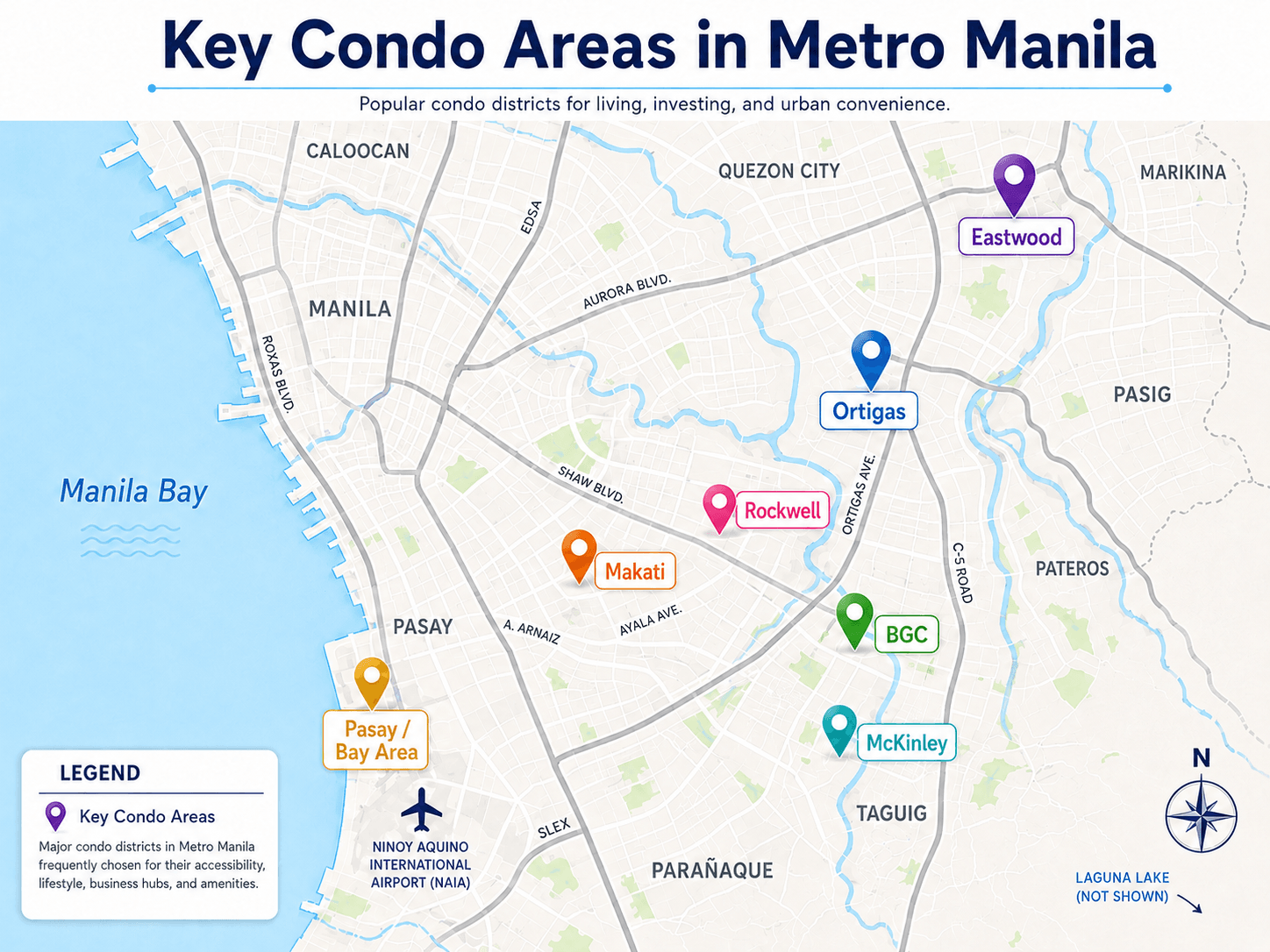
The most popular areas for foreign residents include BGC, Makati, Rockwell, McKinley, Ortigas, Eastwood and the Manila Bay/Pasay area.
BGC – Best for Walkability and Modern City Living
Bonifacio Global City, or BGC, is one of the easiest areas for foreigners to settle into.
It offers:
- international schools such as ISM, Japanese School, British School etc.
- modern condominiums;
- offices;
- restaurants and cafés;
- supermarkets;
- parks;
- Bonifacio High Street;
- Market! Market!;
- SM Aura; and
- a large international community.
For foreigners who prefer to walk rather than drive for every small errand, BGC is one of Metro Manila’s strongest options.
The main disadvantage is price.
BGC is one of the more expensive rental markets in Metro Manila.
Makati – Best for Business and Variety
Makati remains one of Manila’s most established residential and business districts.
It offers a very broad range of condominium choices, from older buildings with larger units to newer luxury towers.
Popular areas include:
- Legazpi Village;
- Salcedo Village;
- Ayala Center;
- Poblacion; and
- areas surrounding the Makati Central Business District.
Makati is especially practical for people working in the Makati CBD.
Rockwell – Best for Premium Residential Living
Rockwell Center is technically part of Makati, but its residential environment is distinct enough to consider separately.
It is popular among executives, expatriates and families who prefer a quieter and more controlled environment.
Power Plant Mall, restaurants, offices and residential towers are concentrated within a relatively compact area.
The disadvantage is cost. Rockwell is generally a premium rental market.
McKinley Hill and McKinley West – Particularly Convenient for Koreans
For Korean residents, McKinley deserves special consideration.
The Embassy of the Republic of Korea is located at 122 Upper McKinley Road, McKinley Town Center, Fort Bonifacio, Taguig. The Korean Embassy itself identifies the location as McKinley Hill along the C-5 corridor.
The Korean International School Philippines is also located in the McKinley area.
For Korean families with children attending the school, living nearby can significantly simplify the daily school commute.
McKinley is therefore particularly attractive to Korean residents who value proximity to:
- the Korean International School Philippines;
- the Korean Embassy;
- BGC;
- Venice Grand Canal Mall;
- C-5 Road; and
- Korean businesses and communities in the Taguig area.
McKinley is not the same as BGC, although the two areas are close to each other.
A Korean family choosing between BGC and McKinley should consider school transportation before deciding purely on the popularity of BGC.
Ortigas – Good Balance Between Location and Price
Ortigas Center is another major business district and is particularly convenient for people working in Pasig, Mandaluyong or nearby Quezon City.
Compared with prime BGC or Rockwell, some buildings can provide better value for money.
Ortigas also offers easy access to malls, offices and restaurants.
Eastwood – Self-Contained Urban Living
Eastwood City is popular among professionals working in nearby BPO and office developments.
It offers:
- condominiums;
- restaurants;
- supermarkets;
- offices;
- entertainment; and
- basic services within the development.
However, the location may be less convenient for someone commuting daily to Makati.
Always test your actual route during weekday traffic before signing a lease.
Pasay and the Manila Bay Area
The Mall of Asia and Entertainment City areas have a large number of newer condominiums.
The area may appeal to people who prioritize:
- proximity to the airport;
- Mall of Asia;
- Entertainment City;
- convention facilities;
- Manila Bay; and
- newer developments.
However, traffic conditions and construction activity differ substantially from building to building.
Inspect the immediate surroundings before committing.
How Do You Find a Condo for Rent in Manila?
There are three common approaches:
- property websites;
- licensed real estate brokers; and
- direct owner listings.
Most foreigners use a combination.
Property Websites for Condo Rentals
Property platforms are useful for comparing buildings, prices and locations before arranging a viewing. Common platforms include:
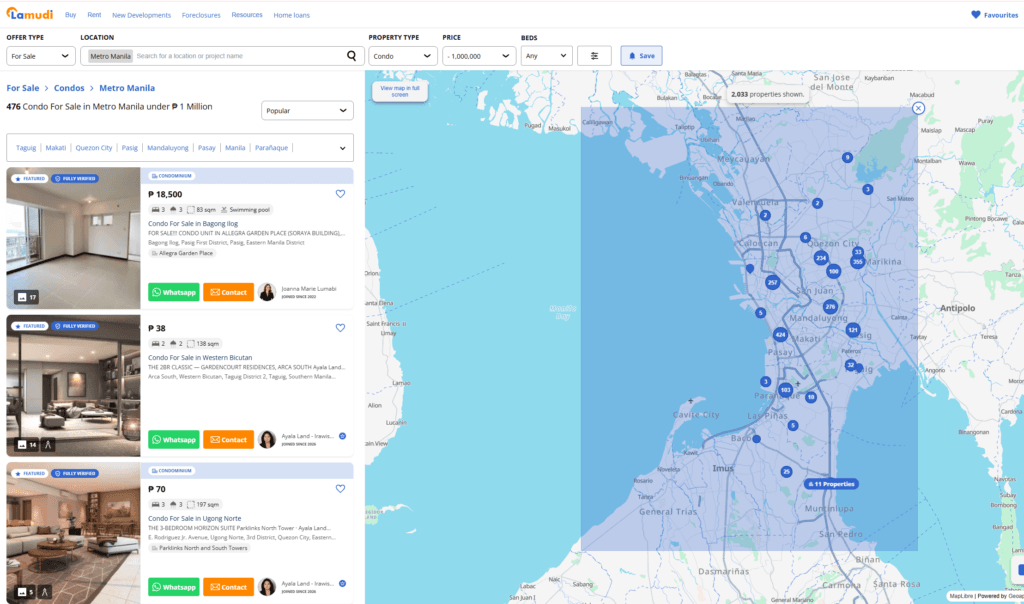
Lamudi Philippines
Lamudi Philippines is one of the country’s best-known property portals. It includes condominium listings for rent and sale throughout Metro Manila. Use it mainly to:
- compare asking prices;
- identify buildings;
- understand available unit sizes; and
- contact agents.
Dot Property Philippines
Dot Property Philippines carries a large number of condominium rental listings throughout Metro Manila. It is useful for comparing BGC, Makati, Ortigas, Pasay and other districts.
Carousell Property
Carousell Philippines Property contains listings from both property professionals and individual owners. It can be useful for finding direct-owner listings, but verification becomes even more important when dealing directly with individuals.
Do You Need a Real Estate Broker to Rent a Condo?
I say yes. You can rent directly from an owner. But, a good real estate broker can make the process substantially easier, particularly if you are new to Manila.
A broker can usually:
- recommend suitable buildings;
- send available listings;
- communicate with multiple landlords;
- arrange unit viewings;
- schedule several units on the same day;
- negotiate rental terms;
- coordinate lease documents;
- communicate with building administration; and
- assist during turnover.
For foreigners unfamiliar with Manila, the ability to inspect several properties efficiently can be particularly valuable.
How to Verify a Real Estate Broker in the Philippines
Real estate brokers are regulated professionals in the Philippines.
Ask your broker for:
- full name;
- PRC license number; and
- contact details.
You can check registered professionals using the Professional Regulation Commission’s online verification service. The PRC verification system allows users to search registered professionals by name or license details.
If someone becomes defensive simply because you ask for professional credentials, that should make you more cautious.
How Much Is the Broker Fee for Renting a Condo?
For a standard one-year residential lease, a commission of approximately one month’s rent is commonly encountered in the Manila property market.
For example:
If the unit rents for:
₱60,000 per month
the broker’s commission may be approximately:
₱60,000
In many conventional transactions, this commission is paid by the landlord.
However, this is a market practice, not a universal rule applying to every rental.
Before starting the transaction, ask:
Who pays the broker’s commission, and are there any brokerage or processing fees that I need to pay?
Do not assume.
For unusual arrangements, shorter leases or co-broker transactions, fee structures may be different.
How Does a Condo Viewing Work in Manila?
Condo viewing is normally straightforward.
However, organizing it correctly can save a lot of time.
Metro Manila traffic makes inefficient viewing schedules particularly frustrating.
Step 1: Give the Broker Your Requirements
Before requesting listings, tell the broker:
- preferred location;
- maximum monthly rent;
- number of bedrooms;
- furnished or unfurnished;
- parking requirement;
- pet requirements;
- expected move-in date;
- length of lease;
- workplace;
- children’s school, if applicable; and
- preferred building, if you already have one.
A good broker should use these details to eliminate unsuitable properties.
Step 2: Ask for Listings Before Scheduling a Viewing
Ask for:
- photographs;
- building name;
- floor level;
- floor area;
- monthly rent;
- number of bedrooms;
- furnishings;
- parking availability;
- whether association dues are included; and
- move-in availability.
This prevents you from traveling to properties that obviously do not meet your needs.
Step 3: Shortlist Three to Five Units
Whenever possible, inspect several units during one viewing schedule.
If you like a particular condominium building, ask:
“Do you have other available units in this building that I can see today?”
This is often more efficient than viewing one building at a time.
Units within the same tower may have significantly different:
- rent;
- furniture;
- condition;
- sunlight;
- floor level;
- views; and
- layout.
Comparing them side by side gives you much better negotiating information.
Step 4: Bring a Valid ID
Condominium security procedures are often strict.
Depending on the building, the broker may need to register your visit in advance.
Security may ask you to:
- present identification;
- register your name;
- leave an ID temporarily;
- receive a visitor pass; or
- wait for owner or broker authorization.
Bring a passport or other acceptable government-issued ID.
What Should You Check During a Condo Viewing?
Do not spend the entire viewing looking at furniture and the view.
You are inspecting both: the condo unit and the condominium building.
Check the Air-Conditioning
Turn on every air-conditioning unit. Check:
- cooling;
- noise;
- condition; and
- apparent age.
Electricity can become a major monthly expense when air-conditioning is used frequently.
Check Water Pressure
Run:
- shower;
- bathroom faucets; and
- kitchen faucet.
Weak water pressure can become surprisingly annoying once you live in the unit.
Check Hot Water
Do not assume hot water is provided throughout the unit. Ask which bathrooms have water heaters and test them if possible.
Check Bathroom Drainage
Run the shower and inspect how quickly water drains.
Check for:
- slow drainage;
- leaks;
- mold;
- damaged sealant; and
- unpleasant odors.
Check the Appliances
If renting furnished, confirm which appliances are actually included.
Check:
- refrigerator;
- microwave;
- stove;
- washing machine;
- television;
- water heater; and
- air-conditioning units.
Ask who is responsible for repairs if an appliance breaks.
Ask About Internet Providers
Do not assume every internet provider is available in every condominium.
Ask:
“Which internet providers are available in this building?”
This is particularly important if you work from home.
Test Your Mobile Signal
Walk into the bedroom and other enclosed areas and check your phone reception. Signal quality can differ significantly within a high-rise building.
Check Sun Direction
One frequently overlooked issue is afternoon sun. A west-facing unit with large windows may become significantly hotter in the afternoon. That can affect both comfort and electricity bills.
Ask:
“Does this unit receive morning sun or afternoon sun?”
Listen for Noise
Stop talking for a minute. Listen. Possible sources include:
- traffic;
- nearby construction;
- elevators;
- neighboring units;
- bars;
- schools;
- mechanical equipment; and
- air-conditioning compressors.
A unit that seems quiet during a Sunday afternoon may feel very different on a weekday morning.
Look for Mold or Water Damage
Pay attention around:
- windows;
- ceilings;
- bathrooms;
- kitchen cabinets;
- air-conditioning openings; and
- exterior walls.
Fresh paint does not necessarily mean there has never been a water problem.
Check Storage Space
Many modern Manila condominiums have surprisingly limited storage. Think about where you will put:
- luggage;
- shoes;
- cleaning equipment;
- clothes;
- kitchen appliances; and
- personal belongings.
Check the View — and What May Be Built Later
An open view can significantly improve a unit. But look at the land directly in front of the building. Ask whether another tower or development is planned.
Today’s open skyline is not necessarily permanent.
Inspect the Building, Not Just the Unit
A good condo inside a poorly managed building can still be a bad place to live. Walk through the common areas.
Check:
- lobby;
- hallways;
- elevators;
- gym;
- swimming pool;
- parking;
- garbage disposal;
- security;
- visitor procedures;
- Grab pickup area;
- entrances and exits; and
- surrounding streets.
Pay Particular Attention to Elevators
Ask yourself:
- How many elevators serve the tower?
- How many are operating?
- How long is the wait?
- Is there a separate service elevator?
- How many units are on each floor?
Elevator waiting time can become a significant daily inconvenience in high-density buildings.
Ask Whether Association Dues Are Included
This is one of the most important questions during a rental viewing:
“Is the monthly rent inclusive of association dues?”
For example:
A listing may say:
₱50,000 per month
But that could mean either:
₱50,000 including association dues
or:
₱50,000 + association dues
The difference can become significant over a year.
PhilifeGuide discusses association dues and other living expenses in more detail in our Condo Living and Transportation in Manila for Newbies article.
Also confirm whether the rent includes:
- parking;
- furnishings;
- association dues; and
- building-related fees.
Normally, tenants separately pay their own:
- electricity;
- water;
- internet; and
- personal services.
But the contract controls, so verify everything.
How to Rent a Condo in Manila Step by Step
The typical process is:
Step 1: Choose the Area
Start with your workplace, school and regular destinations.
Step 2: Compare Listings
Use property portals and broker listings to understand the market.
Step 3: Contact a Broker or Owner
Provide your requirements and budget.
Step 4: Shortlist Units
Try to compare several properties rather than choosing the first acceptable listing.
Step 5: Schedule Condo Viewings
Group properties by neighborhood or building whenever possible.
Step 6: Inspect the Unit and Building
Use the checklist in this guide.
Step 7: Negotiate the Rent and Terms
Rental asking prices are not always final.
There may be room for negotiation depending on:
- market conditions;
- how long the unit has been vacant;
- rental duration;
- payment method;
- comparable units; and
- landlord preference.
Negotiating politely is normal.
Step 8: Verify the Owner
Before paying a substantial deposit, establish that the landlord actually owns the property or that the person representing the landlord has proper authority.
You may ask to see:
- Condominium Certificate of Title;
- owner identification; and
- authorization documents if dealing through a representative.
For greater due diligence, a Certified True Copy of Title can be obtained from the Land Registration Authority.
The LRA specifically states that Certified True Copies may be used for due diligence when buying, selling and leasing properties.
The LRA eSerbisyo system can provide Certified True Copies of Condominium Certificates of Title.
Official resource: Land Registration Authority
Review the Lease Contract Carefully
Do not rely only on messages between you and the broker.
The written lease should clearly state the important terms.
Check:
- landlord name;
- tenant name;
- exact condominium unit;
- parking slot, if applicable;
- lease start date;
- lease end date;
- monthly rent;
- payment schedule;
- advance rent;
- security deposit;
- association dues;
- utilities;
- repair responsibilities;
- furniture inventory;
- early termination;
- renewal conditions;
- pet restrictions;
- subleasing rules;
- security deposit refund;
- move-out conditions; and
- penalties.
If something important was promised verbally, ask for it to appear in the written agreement.
Are Post-Dated Checks Common in Manila Rentals?
Yes.
For long-term leases, many landlords request post-dated checks, commonly called PDCs.
For example, a one-year lease may require twelve checks, each dated for the appropriate monthly rental payment.
Foreigners who do not yet have a Philippine checking account should raise this issue before agreeing to the unit.
Alternative payment arrangements may be possible depending on the landlord.
Do not wait until contract signing to explain that you cannot issue PDCs.
How Much Advance Rent and Security Deposit Should You Expect?
Rental terms vary.
A common arrangement encountered in Metro Manila is:
- advance rent; plus
- security deposit.
Some landlords may request one month advance and two months deposit. Others use different terms.
Treat these as negotiable transaction terms rather than assuming every landlord follows the same formula.
Before signing, ask for a simple written breakdown:
Advance rent: ₱_____
Security deposit: ₱_____
First regular rent payment: _____
Other move-in costs: ₱_____
This helps prevent surprises.
What Is the Security Deposit For?
The security deposit generally protects the landlord against things such as:
- damage beyond ordinary wear and tear;
- unpaid rent;
- unpaid utilities; or
- other obligations allowed under the lease.
The contract should explain:
- how much is being held;
- what can be deducted;
- when it should be returned; and
- what documentation will be required when moving out.
Do not simply assume the full deposit will automatically be returned immediately after you hand back the keys.
Take Photos Before Moving In
This is one of the simplest ways to protect yourself.
During turnover, photograph or record video of:
- walls;
- floors;
- windows;
- furniture;
- appliances;
- kitchen;
- bathrooms;
- cabinets;
- mattresses;
- air-conditioning units; and
- existing scratches or damage.
Keep the original files.
If possible, send a documented inventory to the landlord or broker.
This creates a record of the property’s condition on your move-in date.
Check the Furniture Inventory
For furnished condos, the lease or turnover document should identify what belongs to the landlord.
For example:
- television;
- refrigerator;
- sofa;
- dining table;
- beds;
- mattresses;
- washing machine;
- microwave;
- curtains;
- air-conditioners; and
- smaller appliances.
If something is already broken, record it.
Ask About Parking Before Signing
Do not assume parking comes with the unit.
In many Metro Manila condominiums:
- parking belongs to a different owner;
- parking is rented separately;
- a unit may not have parking at all; or
- parking can add a substantial monthly cost.
If you have a car, parking should be part of your property search from the beginning.
Also inspect the actual parking slot.
Some basement spaces are difficult for larger vehicles.
Ask About Pets
Even if the owner allows pets, the condominium itself may have rules concerning:
- pet size;
- number of pets;
- elevators;
- common areas;
- registration; and
- vaccination records.
Check both:
the landlord’s rule
and
the condominium’s rule.
Check the Commute Before Signing
One of the best things you can do is visit the area during your normal commuting hours.
A property that takes 15 minutes to reach on Sunday may require dramatically more time during weekday rush hour.
If possible:
- leave the condo around your expected work time;
- travel to your workplace;
- repeat the route in the evening.
Your daily commute will probably affect your satisfaction more than the lobby design.
Do Not Judge a Condo Only by Distance
In Metro Manila:
3 kilometers does not necessarily mean 10 minutes.
Traffic routes, intersections, access roads and bridge crossings matter.
This is one reason BGC, Makati and McKinley should be evaluated based on where you actually need to go every day.
Common Mistakes Foreigners Make When Renting a Condo
Choosing the Unit Before Choosing the Location.
Location comes first.
Renting Based Only on Photos
Wide-angle photographs can make small rooms look significantly larger.
Viewing Only One Unit
Compare several options.
Ignoring Association Dues
Always ask whether they are included.
Ignoring Afternoon Sun
A west-facing glass unit may become very hot.
Ignoring Elevator Waiting Time
You will use the elevator several times every day.
Not Testing Water Pressure
Do it during the viewing.
Assuming Internet Is Available
Verify the provider.
Forgetting Parking
Especially common among newcomers who decide to buy or rent a car later.
Not Checking Who Owns the Unit
Do not transfer large amounts of money without basic ownership verification.
Paying Too Quickly
Be cautious if someone pressures you to send money immediately because another renter supposedly wants the unit. A legitimate transaction should allow reasonable verification.
Rental Scam Red Flags
Be cautious when:
- the price is dramatically lower than similar units;
- someone refuses to arrange a proper viewing;
- payment is requested before meaningful verification;
- the broker refuses to provide their identity;
- payment must be sent to an unrelated third party;
- ownership documents cannot be provided;
- the landlord’s identity does not match the documents;
- new fees appear just before signing;
- the actual property does not match the advertisement; or
- you are pressured to transfer money immediately.
If something feels inconsistent, stop the transaction until you understand why.
Practical Condo Viewing Checklist
Save this checklist before viewing properties.
| Check | What to Look For |
|---|---|
| Location | Actual commute |
| Building | Management and condition |
| Security | Visitor and access procedures |
| Elevators | Number, speed and waiting time |
| Unit size | Actual usable space |
| Furnishings | What is included |
| Air-conditioning | Cooling and condition |
| Water | Pressure |
| Hot water | Which bathrooms |
| Drainage | Slow drains or leaks |
| Mold | Ceilings, windows and bathrooms |
| Appliances | Condition and responsibility |
| Internet | Available providers |
| Mobile signal | Test inside unit |
| Sunlight | Morning or afternoon sun |
| Noise | Roads, neighbors and construction |
| View | Possible future construction |
| Storage | Cabinets and luggage space |
| Parking | Included or separate |
| Pets | Owner and building rules |
| Association dues | Included or separate |
| Utilities | Who pays |
| Deposit | Amount and return terms |
| Owner | Verify ownership |
| Broker | Check credentials |
| Lease | Read everything before signing |
Is BGC or Makati Better for Renting?
There is no universal answer.
BGC may suit you better if you value:
- walkability;
- newer developments;
- modern public spaces;
- international restaurants; and
- living close to BGC offices.
Makati may suit you better if you value:
- the Makati business district;
- larger selection of rental units;
- established residential neighborhoods;
- Greenbelt and Glorietta; and
- more variety in older and newer buildings.
The correct choice depends primarily on your daily routine.
Is McKinley a Good Place for Koreans?
Yes, particularly for Korean families.
The Korean Embassy is located on Upper McKinley Road in Taguig.
The combination of the Korean Embassy, Korean International School Philippines, nearby Korean community, and proximity to BGC can make McKinley especially practical for Korean residents.
A family with children attending the Korean school should compare McKinley with BGC based on daily school travel, not just rental prices.
Should You Rent Before Buying a Condo in Manila?
For most foreigners arriving in Manila for the first time, yes.
Renting lets you learn:
- the neighborhood;
- the building;
- traffic;
- your real monthly costs;
- management quality;
- noise;
- transportation;
- nearby services; and
- whether you actually want to stay there long term.
Buying a condominium involves a completely different set of questions, including ownership eligibility, title due diligence, taxes, transaction expenses and property investment considerations.
Rather than combining both subjects into one oversized guide, PhilifeGuide treats them separately.
This article focuses on renting.
A separate PhilifeGuide article will explain how foreigners can buy a condominium in the Philippines, including the actual purchase process and buyer due diligence.
Frequently Asked Questions About Renting a Condo in Manila
Can foreigners legally rent a condo in Manila?
Yes. Foreigners can enter residential condominium lease agreements in the Philippines.
How long is a normal condo lease?
A one-year lease is common for long-term residential rentals, although shorter and longer contracts are available.
Do I need a Philippine bank account?
Not necessarily to search for or lease a condo, but many landlords prefer post-dated checks for long-term rentals. Discuss payment methods before signing.
Who normally pays the broker?
For many standard residential leases, the landlord commonly pays the broker’s commission. Confirm the arrangement before proceeding.
How much is a rental broker commission?
Approximately one month’s rent is commonly encountered for a one-year lease, although fees depend on the agreement.
Should I pay to view a condo?
Ordinary property viewings generally should not require a substantial payment. Treat unexpected viewing fees or reservation requests cautiously.
Should I rent furnished or unfurnished?
New foreigners often find furnished units more convenient because they avoid the cost and difficulty of purchasing furniture immediately.
Long-term residents may prefer unfurnished or semi-furnished units.
Are utilities included in condo rent?
Usually electricity, water and internet are paid separately, but every lease can be different.
Are association dues included?
Sometimes.
Always ask.
How many condos should I view?
As many as possible. If possible, compare at least three to five serious candidates before choosing.
Is BGC expensive to rent?
Generally, BGC is one of Metro Manila’s premium rental markets.
Is McKinley convenient for Korean families?
Yes. McKinley is particularly convenient for Korean families because of the Korean International School Philippines, Korean Embassy and proximity to BGC.
PhilifeGuide’s Practical Recommendation
If you are relocating to Manila for the first time, do not rush into the first attractive condo you see online.
Start with your daily routine.
Where will you work?
Where will your children attend school?
How often will you travel to the airport?
Do you want to walk to restaurants and supermarkets?
Will you drive?
Do you need parking?
Then select the neighborhood.
After that, compare buildings.
And only then compare individual units.
A practical rental decision usually follows this order:
Daily routine → Location → Building → Unit → Price
Not:
Beautiful unit → everything else later.
The cheapest unit is not necessarily the best value, and the most expensive building is not necessarily the most convenient.
For foreigners who are still learning Metro Manila, renting provides the flexibility to discover what actually works before making longer-term decisions.
Useful Resources
- Professional Regulation Commission. Use this service to verify registered real estate professionals (PRC Professional Verification)
- Land Registration Authority. The LRA states that Certified True Copies of Titles can be used for property leasing due diligence (Land Registration Authority)
- LRA eSerbisyo. The portal supports requests for Certified True Copies of titles, including Condominium Certificates of Title (LRA eSerbisyo Portal)
- Korean Embassy in the Philippines. The embassy is located at 122 Upper McKinley Road, Taguig (Embassy of the Republic of Korea in the Philippines)
Last updated: August 31, 2026.
Disclaimer: Rental prices, commissions, deposits, building policies and lease terms vary by property and agreement. This article provides general practical information and is not individualized legal or financial advice.
Leave a Reply