
Mud crab, locally known as alimango, is one of the Philippines’ valuable seafood products. The country has extensive mangrove and coastal areas, established crab-producing communities, and access to major seafood markets in East and Southeast Asia.
To learn more about mud crab species, production areas, market value, and investment potential, read our Mud Crab in the Philippines: A High-Value Species for Investment and Export.
For an investor, however, the opportunity is not simply to produce more mud crabs.
A potentially more attractive business is to solve an important challenge in the Philippine mud crab supply chain:
turning fragmented local supply into consistent, standardized export-quality live mud crabs.
Mud crabs are sourced from many farms, fishing communities, collectors, buying stations and traders. The quality can be excellent, but commercial export buyers generally require more consistency than the traditional supply chain can always provide.
An overseas buyer may require:
- a specific size and weight range;
- males and females separated;
- good meat fullness;
- hard shells and complete limbs;
- consistent quality;
- predictable quantities; and
- reliable shipment schedules.
This creates an opportunity for a centralized mud crab fattening, conditioning, grading and export facility.
For this business model, we assume a 4,000-box crab condominium facility using a Recirculating Aquaculture System (RAS) located around the Lucena City area, potentially including Pagbilao, Quezon.
The company purchases legally sourced mud crabs from Bicol, Quezon and other producing areas, conditions and fattens them in individual boxes, grades them according to export specifications, and consolidates sufficient quantities for overseas buyers.
Mud Crab Export Business at a Glance
| Item | Example Business Model |
|---|---|
| Main activity | Mud crab fattening, conditioning, grading and export |
| Facility | 4,000 individual crab boxes |
| Production system | Crab condominium with RAS |
| Average operating utilization | 90% |
| Crabs stocked per cycle | About 3,600 |
| Example incoming weight | About 400 g |
| Example purchase price | ₱300 per crab |
| Target export weight | About 500 g |
| Example export price | ₱1,000–₱1,200 per crab |
| Main sourcing areas | Bicol, Quezon and other producing areas |
| Proposed facility area | Lucena City vicinity |
| Export gateway | NAIA |
| Estimated initial investment | Around ₱25–₱27 million |
| Illustrative annual operating profit | Around ₱12–₱19 million before tax, financing and depreciation |
These figures are illustrative feasibility assumptions rather than guaranteed returns. Actual performance will depend on survival, cycle length, purchase prices, export prices, electricity, labor, freight and buyer requirements.
Table of Contents
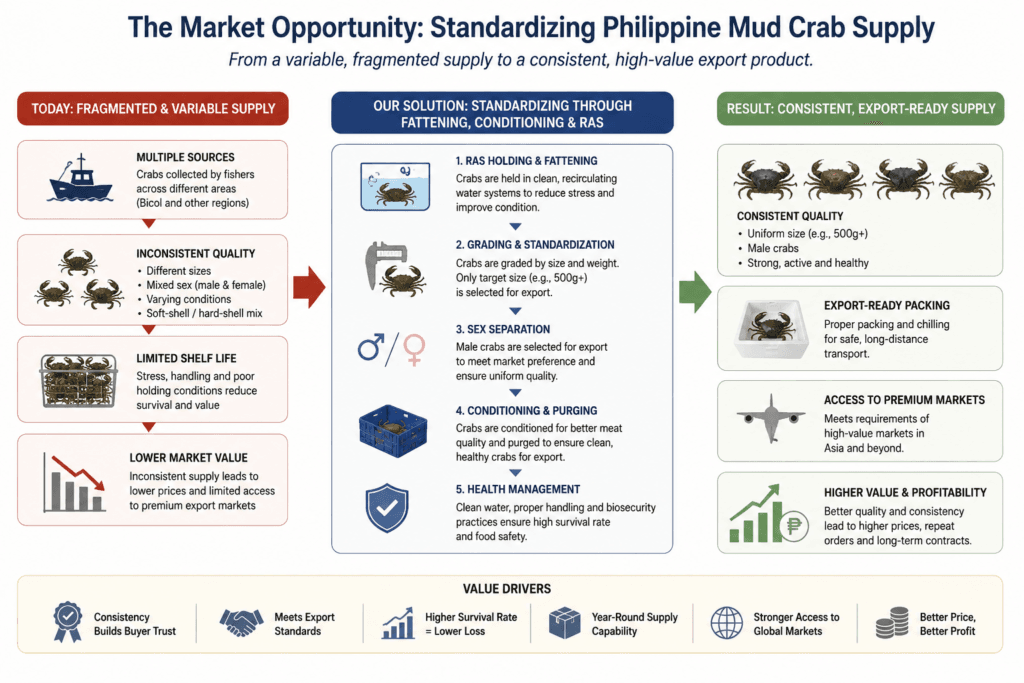
The Market Opportunity: Standardizing Philippine Mud Crab Supply
The Philippines already produces high-quality mud crab.
The opportunity is therefore not based on the idea that Philippine crabs are inferior. The commercial challenge is that production is dispersed among many suppliers and locations.
A buyer looking for several hundred kilograms of live crab cannot simply ask whether mud crab is available somewhere in the Philippines.
The buyer needs to know:
Can you provide the required quantity, of the required weight, sex and quality, on the required shipment date?
That is a different problem.
SEAFDEC research on Philippine mud crab trading shows that crabs are classified according to characteristics including:
- species;
- body weight;
- sex;
- gonad maturity; and
- physical condition.
Very lean, damaged or poor-condition crabs may not qualify for premium export markets.
This creates an opportunity for a company that can purchase mixed supply from different sources and convert it into organized export inventory.
For example, instead of simply holding “mud crabs,” the company may maintain inventory such as:
- male 400–499 g;
- male 500–599 g;
- male 600 g and above;
- female 300–399 g;
- female 400–499 g;
- female 500 g and above; and
- crabs still undergoing conditioning.
Actual grading categories would be determined by the buyer.
The important point is that the exporter can offer specific products rather than an unpredictable mixture of crabs.
Why Fattening and Conditioning Matter for Export
Fattening and conditioning are central to this business model.
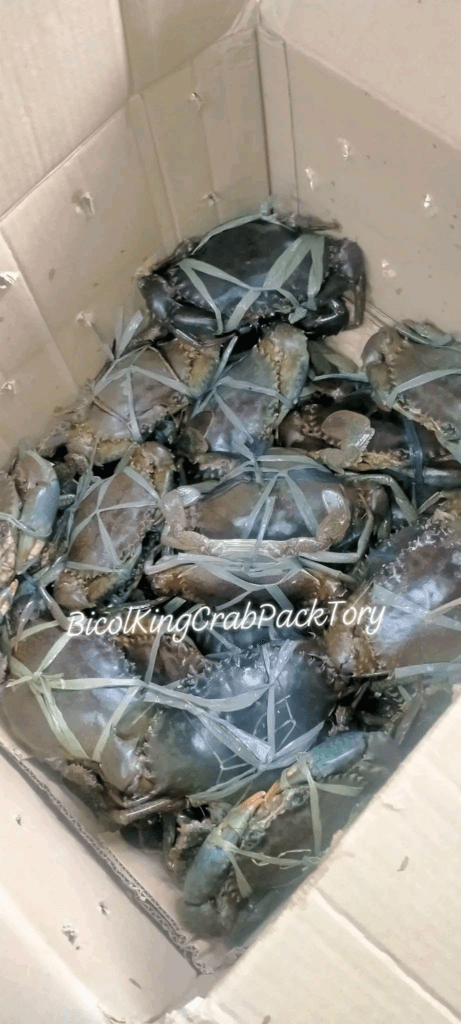
A crab can have an acceptable shell size but still have relatively poor meat fullness.
For example, the company might purchase a healthy crab weighing approximately:
400 g for ₱300
and hold it under controlled conditions until it reaches approximately:
500 g with improved meat fullness and export condition.
The objective is not simply to add 100 grams.
The company is trying to increase the crab’s commercial value by improving:
- meat fullness;
- strength and condition;
- consistency;
- export readiness; and
- grading.
A crab that has recently been collected and transported may also be stressed.
A conditioning facility gives the company time to:
- stabilize the crab;
- feed it properly;
- identify weak animals;
- monitor mortality;
- improve its physical condition; and
- select only strong crabs for export.
This is particularly important for live seafood because the crab still needs to survive:
packing
↓
road transportation
↓
airport handling
↓
international flight
↓
arrival at the importer.
The company therefore adds value in three stages:
Fattening improves fullness.
Conditioning improves export readiness.
Grading creates a standardized commercial product.
Why Consistent Quantity Matters
Quality alone is not enough for an export business.
An overseas importer also needs volume consistency.
A buyer may want 500 kg of a particular grade every week or several shipments per month.
Suppose the buyer orders:
500 kg of male crabs weighing 500–600 g each.
If the average crab weighs approximately 550 g, the exporter needs about:
900 export-ready male crabs of approximately the same grade at one time.
There may be thousands of mud crabs available throughout several provinces, but that does not necessarily mean 900 crabs meeting the same specification can be assembled immediately.
This is where the 4,000-box facility becomes commercially important.
Crabs from different suppliers can arrive at different times and be individually:
- weighed;
- sexed;
- inspected;
- conditioned;
- fattened;
- graded; and
- accumulated until a buyer’s required quantity is available.
The facility therefore acts as a buffer between irregular local supply and predictable international demand.
The 4,000-Box Business Model
The proposed facility contains 4,000 individual crab boxes.
Assume an average utilization rate of 90%.
This means approximately 3,600 crabs are stocked during each operating cycle.
For financial modeling, assume:
- incoming crab weight: approximately 400 g;
- purchase cost: ₱300 per crab;
- target export weight: approximately 500 g;
- export selling price: ₱1,000–₱1,200 per crab;
- saleable/exportable rate: 92%; and
- approximately 10 commercial cycles per year.
The 10-cycle assumption allows time for conditioning, cleaning, grading, turnover and operational interruptions rather than assuming the boxes operate continuously every day of the year.
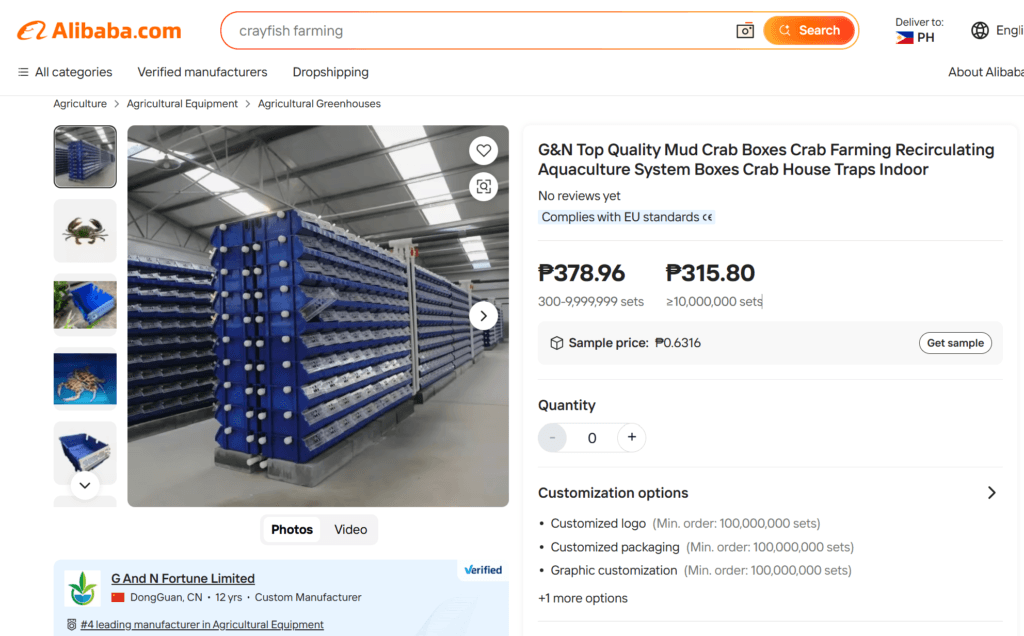
Why Individual Crab Boxes?
Mud crabs are aggressive and can fight or cannibalize one another when kept together.
Individual compartments provide several advantages:
- reduced fighting and cannibalism;
- individual feeding;
- easier mortality detection;
- accurate inventory;
- individual weight records;
- easier sex separation;
- easier grading;
- simplified harvesting; and
- better traceability.
Each crab effectively becomes an individual unit of inventory.
The company can record:
- supplier;
- source province;
- incoming weight;
- sex;
- condition;
- purchase price;
- stocking date;
- feed;
- final weight;
- final grade;
- sale price; and
- buyer.
This information can eventually identify which suppliers and crab categories generate the highest margins.
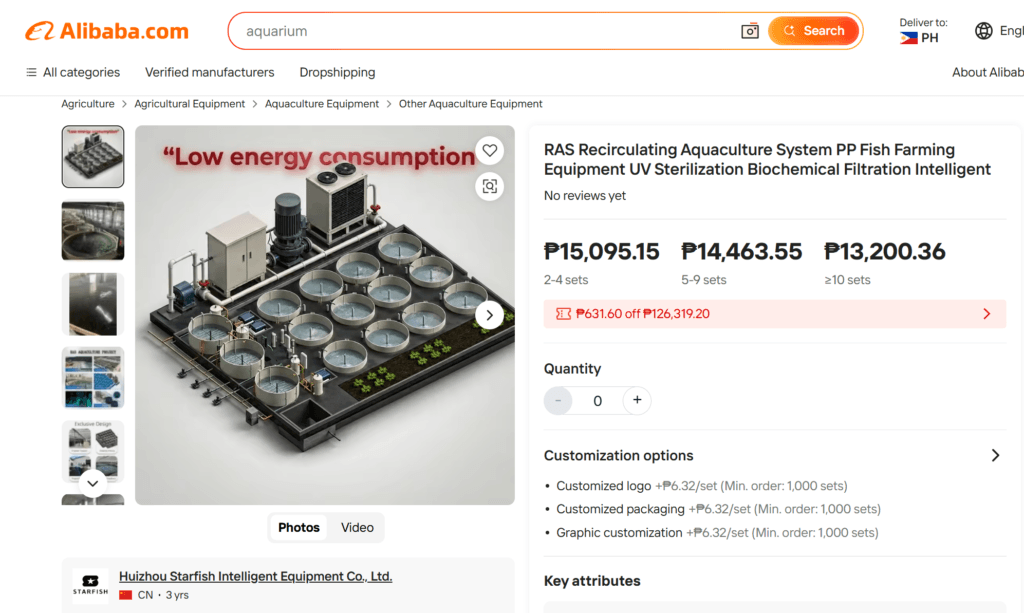
What Is a Recirculating Aquaculture System?
A Recirculating Aquaculture System, or RAS, continuously treats and reuses water rather than relying entirely on continuous water replacement.
A simplified system could operate as follows:
Crab boxes
↓
solids removal
↓
mechanical filtration
↓
biological filtration
↓
aeration and oxygenation
↓
water treatment
↓
water returned to the crab boxes
A commercial system may also include:
- pumps;
- reservoirs;
- biofilters;
- UV treatment;
- ozone;
- dissolved oxygen monitoring;
- pH monitoring;
- salinity monitoring;
- temperature monitoring;
- ammonia monitoring;
- automatic alarms;
- backup pumps; and
- standby generators.
RAS allows thousands of individual crabs to be managed under relatively controlled conditions, but it also creates dependence on electricity and equipment reliability.
Backup power is therefore essential.
Why Locate the Facility Around Lucena City?
For this business model, the Lucena City–Pagbilao area is strategically interesting.
The main reason is its position between the crab-producing areas of Southern Luzon and Bicol and the export infrastructure of Metro Manila.
Bicol is one of the country’s important mud-crab-producing regions.
A procurement network could potentially include:
- Camarines Norte;
- Camarines Sur;
- Albay;
- Sorsogon;
- Quezon; and
- other suitable producing areas.
The supply chain could therefore operate as:
Bicol and Southern Luzon suppliers
↓
Lucena-area consolidation facility
↓
fattening and conditioning
↓
grading and packing
↓
NAIA
↓
overseas buyer
Lucena is far enough from Metro Manila that suitable commercial space may potentially be less expensive than in some industrial areas of Laguna, Cavite or Metro Manila, while remaining within practical trucking distance of NAIA.
The company should nevertheless compare actual long-term warehouse quotations before choosing the final site.
For a foreign-owned company, leasing rather than purchasing land can also be attractive.
Capital can be concentrated on:
- production equipment;
- RAS;
- backup power;
- working capital;
- procurement; and
- export operations
instead of being tied up in real estate.
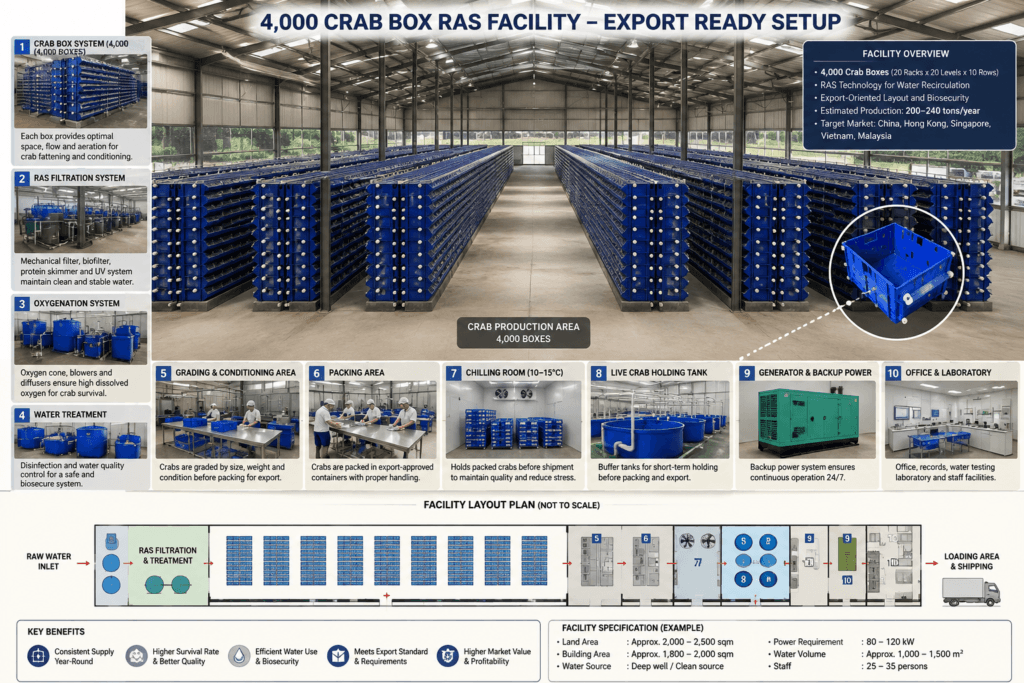
Estimated Cost to Establish a 4,000-Box Facility
A 4,000-box operation requires considerably more than the boxes themselves.
A reasonable preliminary capital budget could look like this:
| Investment Item | Estimated Cost |
|---|---|
| 4,000 crab boxes | ₱6.2M |
| International freight, import and inland delivery | ₱1.2M |
| Multi-level racks and support structure | ₱1.8M |
| RAS tanks, filters, pumps and blowers | ₱4.2M |
| Plumbing, drainage and water distribution | ₱1.2M |
| Electrical upgrading and backup generator | ₱2.2M |
| Warehouse fit-out | ₱1.5M |
| Packing, weighing and holding equipment | ₱0.8M |
| Sensors, alarms and basic testing equipment | ₱0.6M |
| Engineering, permits and professional fees | ₱0.7M |
| Contingency | ₱1.6M |
| Initial working capital | ₱4.0M |
| Estimated Total Investment | ₱26.0M |
A practical preliminary investment range would therefore be approximately ₱25–₱27 million excluding the purchase of land.
This assumes the company leases the facility.
Actual costs could vary significantly depending on:
- building condition;
- RAS design;
- import freight;
- electrical capacity;
- generator requirements;
- water source;
- drainage;
- equipment specifications; and
- local construction prices.
Example Annual Production
Using the assumptions above, 3,600 crabs stocked per cycle × 10 cycles per year = 36,000 crabs purchased annually.
At an assumed 92% saleable/exportable rate, 36,000 × 92% = 33,120 exportable crabs per year.
At approximately 500 g each, this represents about 16.6 metric tons of saleable live mud crab annually.
The remaining 8% represents mortality, rejection, lower-grade product or other production loss incorporated into the model.
Annual Crab Procurement Cost
At ₱300 per incoming crab and 36,000 crabs annually, the annual crab purchasing cost would be 36,000 × ₱300 = ₱10.8 million.
This is likely to be the largest single operating expense.
The ability to maintain the ₱300 procurement assumption is therefore critical to the economics.
Example Annual Revenue
Assume 33,120 exportable crabs annually.
At ₱1,000 per crab, 33,120 × ₱1,000 = ₱33.12 million annual revenue.
At ₱1,100 per crab, 33,120 × ₱1,100 = ₱36.43 million annual revenue.
At ₱1,200 per crab, 33,120 × ₱1,200 = ₱39.74 million annual revenue.
This illustrates how strongly profitability depends on achieving the premium export price.
Estimated Annual Operating Costs
A preliminary annual operating budget could look like this:
| Operating Expense | Estimated Annual Cost |
|---|---|
| Purchase of 36,000 crabs | ₱10.8M |
| Feed | ₱0.9M |
| Electricity | ₱1.8M |
| Labor | ₱2.4M |
| Facility lease | ₱1.2M |
| Packing and local export logistics | ₱1.8M |
| RAS maintenance and replacement parts | ₱0.8M |
| Administration, permits and testing | ₱0.7M |
| Miscellaneous and operational reserve | ₱0.5M |
| Estimated Annual Operating Cost | ₱20.9M |
These costs are planning assumptions and should eventually be replaced with actual quotations.
International airfreight requires special treatment.
For this example, the ₱1,000–₱1,200 export selling price is assumed to represent the amount attributable to the exporter before corporate tax, with international airfreight either charged separately to the buyer or otherwise not included as an additional cost in this model.
If the Philippine exporter must absorb international airfreight from the quoted selling price, profitability would be materially lower.
This should be clearly negotiated in the export contract.
Projected Annual Operating Profit
Using estimated operating costs of ₱20.9 million per year, the illustrative operating results would be:
| Export Price per Crab | Annual Revenue | Estimated Operating Cost | Operating Profit |
|---|---|---|---|
| ₱1,000 | ₱33.12M | ₱20.90M | ₱12.22M |
| ₱1,100 | ₱36.43M | ₱20.90M | ₱15.53M |
| ₱1,200 | ₱39.74M | ₱20.90M | ₱18.84M |
Therefore, under these assumptions, a mature 4,000-box facility could potentially generate approximately ₱12–₱19 million in annual operating profit before:
- corporate income tax;
- depreciation;
- loan interest;
- financing charges;
- extraordinary mortality;
- major equipment replacement; and
- owner distributions.
Is a Mud Crab Export Business in the Philippines Profitable?
A useful middle case is:
| Item | Base-Case Assumption |
|---|---|
| Purchase price per crab | ₱300 |
| Incoming crab weight | Approximately 400 g |
| Target export weight | Approximately 500 g |
| Export selling price per crab | ₱1,100 |
| Crab boxes | 4,000 |
| Average utilization | 90% |
| Crabs stocked per cycle | 3,600 |
| Commercial cycles per year | 10 |
| Crabs purchased annually | 36,000 |
| Exportable/saleable rate | 92% |
| Exportable crabs annually | 33,120 |
| Estimated annual revenue | ₱36.43 million |
| Estimated annual operating expenses | ₱20.90 million |
| Estimated annual operating profit | ₱15.53 million |
On an initial project investment of approximately ₱26 million, this would represent a very attractive operating return.
However, this result is only achieved if the company can actually maintain the assumed:
- ₱300 procurement price;
- 92% saleable rate;
- 10 annual cycles;
- ₱1,100 export selling price;
- manageable electricity cost;
- reliable crab supply; and
- reasonable logistics costs.
These assumptions should therefore be regarded as the commercial targets that must be proven, not guaranteed outcomes.
Why the Margin Can Be High
At first glance, purchasing a crab for ₱300 and selling it for ₱1,000–₱1,200 may appear to create an unusually large margin.
But the company is not simply buying and reselling the same product. Between purchase and export it assumes:
- mortality risk;
- feeding cost;
- electricity;
- RAS operation;
- labor;
- warehouse cost;
- grading;
- conditioning;
- packing;
- rejected inventory;
- transport risk;
- export compliance; and
- buyer risk.
More importantly, it transforms a relatively inconsistent locally sourced crab into a product meeting an overseas buyer’s specification.
The value created is therefore not simply the additional 100 grams of weight. It is the combination of:
- fullness
- quality control
- uniform grading
- sex separation
- reliable quantity
- export access.
That is the economic foundation of the business.
Procurement Becomes a Competitive Advantage
The company does not necessarily need to own large crab farms.
Instead, it can establish relationships with:
- fisherfolk;
- crab farmers;
- cooperatives;
- collectors;
- buying stations; and
- provincial traders.
Every incoming batch should be recorded.
Important information includes:
- supplier;
- source location;
- species;
- sex;
- weight;
- fullness;
- buying price;
- mortality;
- conditioning time; and
- final export grade.
Over time, the company can determine which suppliers consistently generate the greatest profit.
For example, one supplier may offer cheaper crabs but experience high mortality.
Another may charge slightly more but provide stronger crabs that achieve export condition much faster.
This data can eventually become an important competitive advantage.
Export Compliance
The Bureau of Fisheries and Aquatic Resources (BFAR) is a key regulator for live seafood exports from the Philippines.
Depending on the product and destination, requirements can include:
- establishment or exporter registration;
- inspection;
- health certification;
- quarantine procedures;
- export commodity clearance;
- traceability documents; and
- shipment-specific requirements.
Importing countries can impose additional requirements relating to:
- animal health;
- species;
- packaging;
- size;
- origin;
- certificates; and
- import permits.
The export market should therefore be identified before the company establishes its final operating specifications.
Can a Foreigner Own the Business?
Potentially, yes, depending on the exact corporate activities and applicable Philippine foreign-investment rules.
A foreign-owned Philippine corporation could potentially:
- lease the facility;
- purchase equipment;
- operate the RAS;
- purchase legally sourced mud crabs;
- employ Filipino workers;
- grade and pack the crabs; and
- export the finished live product,
subject to the applicable corporate, fisheries, environmental, local-government and export regulations.
Professional legal review should be obtained before registration.
For a broader explanation of foreign-equity rules, see our Foreign Ownership in the Philippines: What Businesses Can Foreigners Own in 2026?.
Also, for the general company-registration process, see our How to Register a Business in the Philippines: A Practical Guide for 2026.
Potential BOI Incentives for a Mud Crab Export Business
A commercial mud crab fattening and export facility may also be eligible to apply for incentives from the Philippine Board of Investments (BOI).
Under the current Strategic Investment Priority Plan, qualified agriculture, fisheries, aquaculture, and export-oriented projects may receive fiscal incentives such as an Income Tax Holiday, followed by either the 5% Special Corporate Income Tax or the Enhanced Deductions Regime, depending on the project’s classification and eligibility. For an RAS-based operation, enhanced deductions may be particularly relevant because electricity is a major operating cost.
A mud crab project that purchases locally sourced crabs, adds value through conditioning and grading, employs Filipino workers, uses controlled aquaculture technology, and exports most of its production may therefore be worth presenting to BOI for evaluation. However, incentives are not automatic, and the project should remain financially viable even without them.
For the latest eligibility rules and incentive packages, investors should refer directly to the Philippine Board of Investments and the CREATE MORE Act.
Major Risks
The projected profitability makes the business attractive, but several variables could materially change the result.
Crab Purchasing Price
The ₱300 assumption is fundamental. If procurement prices rise sharply, margins decline immediately.
Survival and Exportable Yield
The model assumes 92% of stocked crabs ultimately become saleable. A lower rate would reduce revenue while most costs remain.
Conditioning Time
The model assumes approximately 10 commercial turnovers annually. Longer cycles reduce annual capacity.
Export Selling Price
A decline from ₱1,200 to ₱1,000 changes annual operating profit by more than ₱6 million under this model.
Consistent Supply
A 4,000-box facility is inefficient if thousands of boxes remain empty because suitable crabs cannot be sourced.
Electricity and RAS Failure
Continuous circulation, aeration and filtration are critical. Backup power and redundant equipment are essential.
Airfreight
Live seafood is particularly sensitive to freight costs and flight availability. The company should determine clearly whether freight is paid by the exporter or buyer.
Traffic and Airport Delays
Live crabs transported from Lucena to NAIA require sufficient logistical contingency.
Market Access
Having export-quality crabs does not guarantee an overseas buyer. The company needs established importers and recurring orders.
Final Thoughts
The opportunity in Philippine mud crab export is not simply about growing a crab from 400 g to 500 g.
The more important opportunity is to create a standardized export product from a fragmented domestic supply chain.
A commercial buyer needs:
- uniform weight;
- proper fullness;
- males and females separated;
- consistent physical quality; and
- sufficient quantity delivered reliably.
A 4,000-box RAS crab condominium facility can potentially provide that missing link.
Crabs collected from Bicol, Quezon and other producing areas can be consolidated around the Lucena area, individually conditioned and fattened, classified according to buyer specifications, and exported through Manila.
Under the illustrative commercial assumptions used in this guide:
- initial investment: approximately ₱26 million;
- crabs purchased annually: approximately 36,000;
- purchase cost: ₱300 per 400 g crab;
- exportable production: approximately 33,120 crabs;
- target export size: approximately 500 g;
- selling price: ₱1,000–₱1,200 per crab;
- annual revenue: approximately ₱33–₱40 million; and
- illustrative operating profit: approximately ₱12–₱19 million per year before tax, depreciation and financing.
The strongest part of this business is not the crab box or even the RAS technology by itself.
The competitive advantage is the ability to consistently deliver the right size, the right sex, the right fullness, the right quality and the right quantity at the time an overseas buyer needs it.
If a company can build that capability while maintaining disciplined procurement and low mortality, mud crab fattening and conditioning could develop into a specialized Philippine live-seafood export business, rather than simply another aquaculture operation.
Sources and References
- SEAFDEC Aquaculture Department — Farming Mangrove Crab (Mud Crab)
Covers Philippine mud crab species, major producing regions including Bicol, culture methods, and the local and export-market importance of mangrove crab.
SEAFDEC: Farming Mangrove Crab - SEAFDEC/AQD — Overview of the Mud Crab Industry in the Philippines
Useful background on the Philippine mud crab industry, including Scylla species, commercial farming, and short-term fattening of lean crabs. The study notes that mud crab fattening typically involves market-size lean crabs and has historically been conducted over relatively short periods.
SEAFDEC: Overview of the Mud Crab Industry in the Philippines - SEAFDEC/AQD — Mangrove Crab Culture (2025)
A recent technical guide covering hatchery, nursery, grow-out, water-quality management, transportation, and economics of mangrove crab culture in the Philippines.
SEAFDEC: Mangrove Crab Culture 2025 - Bureau of Fisheries and Aquatic Resources — Export Certification
BFAR’s official page provides forms and requirements relating to export certification, including health certificates for live food fish and Export Commodity Clearance for fishery and aquatic products.
BFAR Export Certification - BFAR — Requirements for Export of Live Aquatic Animals
BFAR maintains specific guidelines for exports of live aquatic animals, including crustaceans, fish, and invertebrates.
BFAR Fisheries General Memorandum Orders - BFAR — Registered Exporters of Live Aquatic Animals
BFAR’s current exporter list provides useful evidence that Scylla serrata is already handled by registered Philippine live aquatic animal exporters.
BFAR Registered Live Food Fish Exporters - Republic Act No. 11647 — Foreign Investments Act Amendments
The official Lawphil text is useful for verifying the legal framework governing foreign investment and foreign ownership in Philippine enterprises.
Republic Act No. 11647 – Lawphil
Disclaimer: This article is intended for general information and preliminary business-feasibility purposes only. Financial calculations are illustrative assumptions and are not guaranteed returns. Crab prices, survival, export prices, freight, facility costs and regulatory requirements can change substantially. Investors should obtain actual supplier quotations, buyer contracts, technical advice and guidance from SEC, BFAR, BIR, DENR, the relevant LGU and qualified professional advisers before investing.
Leave a Reply